Quadforce of Dance Congress Expenses #2: Travel

[Disclosure: As of the time of this writing, I am not directly affiliated with any of the businesses whose services I describe in this post nor have I been hired to advertise for any of them. Anything written in this post is my objective advice. Any advice in this blog does not constitute legal or medical advice and is provided as is with no liability to #FrugalCongressLife or the author.]

Once you have your pass, travel to the congress is the next major expense you must consider. Obviously, if you are going to a local congress your only cost will be the cost of gas or transit, but as you get more into the dance congress scene, you will also want to go to out of town congresses that you will have to drive, take the train/bus, or fly to.

Driving:

Gas and tolls can cost more than you think. For me here on the Maryland side of DC, just getting out of the state of Maryland to points north is about $15 in tolls by itself. The best frugal practice for any congress in driving distance, particularly on the higher end of driving distance, is to ride-share with as many people as possible and split the cost of gas and tolls. If you’re willing to add an extra hour or two to your drive, any GPS app such as Waze also has an option for avoiding toll roads and tollbooths.

http://www.tollguru.com is a good resource for calculating the cost of gas and tolls for a car trip that I use frequently.

Train/bus:

If the congress is on a train or bus route, this is a good option to consider. If your congress is in flying distance, taking the train is less expensive, but will take much longer (north of 10 hours). A bus such as Greyhound, Bolt Bus, or MegaBus is way less than the train (as little as $15-20 one way depending on your destination and travel time), but comfort and legroom are sacrificed for this lower cost, particularly on a crowded bus (MegaBus in particular has very small seats). Compression socks are a good clothing accessory to look into for comfort and healthy circulation when traveling in cramped conditions such as a bus or plane for an extended period of time.

Flying:

Everything I’ve said so far has been pretty obvious and self-evident: ride-share to save money on gas and tolls, the bus is cheaper than the train, simple enough right? Flying is a little more involved and there’s more to it than what is obvious. Flying is the most expensive form of travel, but it is necessary when driving or taking the train/bus just isn’t a realistic option.

The most frugal way to fly is to use a budget airline such as Spirit Airlines or Frontier. To supplement my own personal experience, I will be borrowing a good amount of information from Keven Alvarado’s guide to flying Spirit Airlines for this section, which helped me a lot when I booked my first Spirit flight. I will link this guide in a future update to this article if I can find it anywhere online outside of FB or Messenger.

The most crucial thing one must understand about the new wave of budget airlines like Spirit is that the flight you get with your ticket is “un-bundled”… for the relatively low ticket price, you get the seat you sit in, transportation to your destination, and that is it. You get no food or in-flight entertainment with your ticket; all of that is charged separately. Make sure you have movies, games that you can play offline, music, and whatever else downloaded to your phone or tablet along with a good pair of noise-canceling headphones, because whatever is on your phone or tablet WILL be your in-flight entertainment. Bring an empty water bottle and fill it at an airport water fountain after you get through TSA.

Any checked bags are charged separately.

You get ONE “personal item” for free on a Spirit flight – your personal item is a small bag that you can carry on for free and that carry on item has to fit all the way inside of a bin at the gate that looks like this:
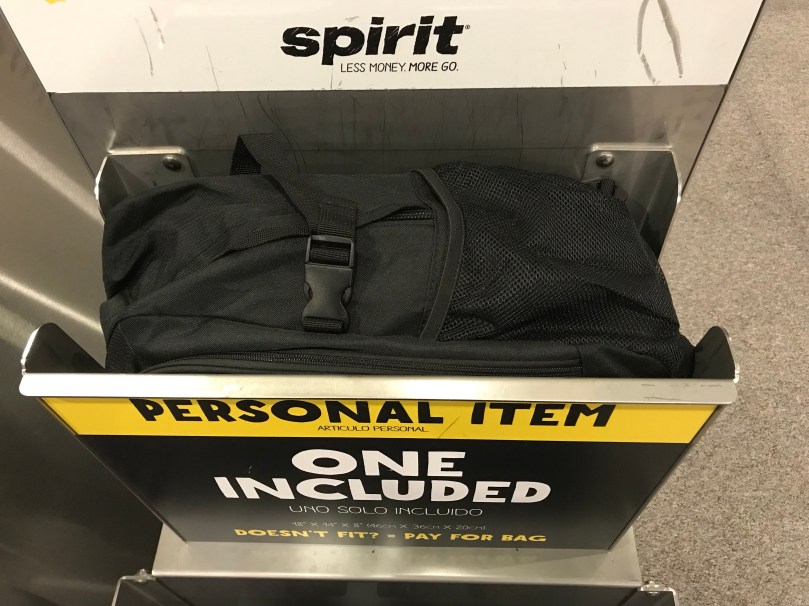
Yes, it has to fit in that little bin, so you have to have a bag that will fit in that bin to begin with and you can’t overstuff it to the point where it won’t fit. If it doesn’t fit, you have to check it, period, and that’s extra $$$. Any other checked bags are also extra $$$.

Here is the bag I use for Spirit flights. It conforms to Spirit and Frontier’s size requirements for personal items as long as you don’t overstuff it. A search for “Spirit bag” on Amazon will reveal abundant others that also meet Spirit and Frontier’s requirements.

If you have a lot of bags that you’ll need to check for any reason Spirit won’t be for you as with the checked bag fees it will work out to the cost of one of the major non-budget airlines anyway.

Check out Laura Riva’s post on how to pack efficiently for travel to a congress here. I would add to her post that compression cubes are a very effective way to pack down your rolled up clothes and other such items even further and fill the space even more efficiently – buy some here.

Flying Spirit is overall best for weekend or 4-5 day trips where you can fit everything you need into a Spirit bag without overstuffing it excessively. Keep in mind that Spirit does not go to every airport either, this is also something that must be researched.

Spirit also has a “big front seat” that you can purchase for an extra $35 each way that is their equivalent of “first class”. Since I’m a pretty big dude, I’ll likely be doing this when I go to Dallas Bachata Festival in November, as cramming into their small seats for 8+ hours is not very comfortable for a big dude, even with compression socks.

The best time to buy plane tickets at their cheapest is 1-2 months out from your flight date. Flying out on a weekday is optimal if you can swing it as flying out on Friday and back on Sunday adds $50-90 to your ticket price on average. Research prices for your desired flight on spirit.com in an incognito or private window (very important that the window you do your research in be incognito or private because otherwise it will be tracked with cookies and the price will go up) until you are happy with the price. Then, go directly to the airport and buy your ticket there to save the $15-30 you would be charged for online processing fees if you bought online. Ticket prices literally change day to day – if the price seems too high, try another day. I got a Friday AM flight from Baltimore-Washington International (BWI) out to this year’s Chicago Salsa Bachata Festival (near O’hare International Airport [ORD]) and return flight the following Sunday evening late last March for $250 total by purchasing my tickets directly at the airport in early February, and I’m sure it would have been even less if I had flown on weekdays, but the missed work would have offset any savings too much. Anything under $200 round trip is a good deal, but some people have been able to go as low as $40-50 round trip (I may have to have those people teach me their ways before I go to Dallas).

Here’s another thing you should know about Spirit that isn’t in most guides to Spirit. They’re late. Frequently. Delays and cancellations are even more of a fact of life on Spirit than they are on any other airline. The money you save can make dealing with this fact worth it, but make sure you schedule your flights well in advance of any workshops or bootcamps you want to take or parties you want to attend. If flying out Friday, an early AM departure is very advisable. Of course, always assume your flight is going to be on time and arrive with enough time to get through TSA and be at your gate a minimum of 2-3 hours before your flight.

If you’re taking a non-budget major airline that isn’t Spirit or Frontier, a lot of the non-Spirit-specific info for packing efficiently etc. applies also. For these airlines, Google Flights or Cheapflights.com are good resources for finding the cheapest flights possible. Scheduling your flights on a weekday, if at all possible, will get you the cheapest flights on any airline.

That’s all I got for travel. I know most of this was pretty obvious stuff outside of the specifics of flying, but it’s relevant to lay everything out there when planning for a frugal congress is concerned. My next post on the big daddy of the Quadforce of Congress Expenses, lodging, will have considerably more meat to it (I can make this promise with confidence because I actually wrote this post last after completing the other three Quadforce of Dance Congress Expense posts). If you have other suggestions or insights regarding congress travel, post it in the comments.

– Owen

Quadforce of Dance Congress Expenses #1: The Pass

[Any advice in this blog does not constitute legal or medical advice and is provided as is with no liability to #FrugalCongressLife or the author.]

When planning to attend a dance congress, it is self-evident that the first thing one will spend money on is the ticket to the congress itself, commonly known as the pass.

Because, again, I like to ELI5 things, there are several levels of dance congress passes, listed here from most expensive to least expensive:

VIP full pass: all the access of a full pass (see below) plus some extra perks that vary depending on the individual event but may include front row seats at the performances, a t-shirt, an exclusive VIP dance area or party, etc.  Extra perks included with a VIP pass will be specified by the event organizer.

Full pass: gives the pass holder access to all scheduled congress activities… workshops, day parties, performances, night parties, you name it, you have access to everything, with the possible exception of separate bootcamps not included in the pass that may be an extra cost, usually clearly specified by the event’s organizers.  Obviously, VIP perks are not included with a full pass, but you have access to everything else.

Performer’s pass: Similar to a full pass, but offered exclusively to individuals performing at the event

Party pass: access to only the event’s performances, night parties and any night workshops that may be happening (which is rare)

Full individual day pass: access to all non-VIP scheduled congress activities on that particular day, minus any bootcamps or other activities not included in the price of the full pass (see above)

Individual night pass: access to only the event’s performances, night parties, and other activities on that particular night

So now that you know the different levels of congress passes, I’ll get into all the #FrugalCongressLife strategies I know of to get your passes for as little money as possible shortly, but first, this PSA, which I feel should not even need to be said but sadly is still necessary for some people.

PSA: DO NOT SNEAK IN TO ANY DANCE CONGRESS, FESTIVAL, WEEKENDER, OR WEEKLY DANCE SOCIAL OR CLASS FOR THAT MATTER WITHOUT PAYING.  SNEAKING INTO DANCE EVENTS WITHOUT PAYING IS AN UNFATHOMABLY SHITTY THING TO DO AND CONTRIBUTES TO THE DEMISE OF DANCE EVENTS AND SCENES.

I think I can confidently make this statement and most people will agree.  Dance festivals cost a lot of money to put on, between artists/instructors, hotel expenses, travel, rented dance floors, DJs, lighting, and everything else in between, and they are usually put on by an individual who is doing so as a labor of love and making little if any money, and are lucky not to lose money.  You are not acting on any kind of moral imperative or fighting a big greedy corporation or any of that kind of nonsense by sneaking in to a dance festival, you are simply screwing over an individual who is organizing the event as a labor of love for the dance community, and are helping contribute to the demise of dance events in that particular community.  Many dance events have also ramped up security in response to people sneaking in and you will likely be caught and thrown out anyway.  So just don’t do it.

Ok, now with that PSA that really shouldn’t have been necessary out of the way, on to the LEGIT #FrugalCongressLife strategies for getting your pass for as little as possible.

Full Passes vs. Party Passes:

I generally recommend buying the full pass for as many congresses as possible, because there may be workshops that you want to take and financially supporting the event as much as you possibly can is best practice for helping to ensure the prosperity and continued success of that particular congress.  There are ways to buy a full pass as frugally as possible that I will cover next.  However, I understand that this is not an option for everyone, and this is the #FrugalCongressLife blog after all.  If it is really between buying a party pass or not going for you, I’m sure any event organizer would rather you buy a party pass or day pass than no pass at all at the end of the day.

Early Bird Gets The Frugal Worm:

BUY.  YOUR.  PASS.  EARLY.  As early as possible.  For the vast majority of dance congresses and festivals, early bird full and/or VIP passes and even super early bird full and/or VIP passes are generally offered at a very low cost immediately following the events announcement (usually a year out or more from the time of the event) and passes then ramp up in price leading up to the day of the event.  It literally pays to get your pass early.  I make it my personal practice to have 90% of the full passes for congresses I plan to attend at the full pass level in any given year by the end of January that year.  It has saved me hundreds of dollars on congress passes over time, and it does serve a good purpose as event organizers frequently have to pay advance deposits on the hotel, etc.

Dance organizations and promo codes:

If you can get into a dance organization, many of them offer discount codes for as much as 25% off any level of congress pass.  I will cover a few such organizations in future posts.  Sometimes, promo codes are also offered to the general public outside of dance organizations – keep an eye out on Facebook, Meetup, or local dance events for these.

Volunteering: 

For most dance congresses, volunteering to work a certain number of hours at the festival during certain shifts performing tasks such as processing registrations, moving equipment, or driving artists to and from the airport will get you a full pass to the festival in exchange for this work.  These volunteers are essential personnel, and a festival would not run nearly as smoothly without them, so they are always in demand, but volunteering obviously has its upsides and downsides.  I personally have no experience with volunteering at a congress or festival, as this is not a preferred option for me and not one I have yet had to take.  See this post on Laura Riva’s excellent dance blog “The Dancing Grapevine” to determine if volunteering at a congress is right for you.  I will be soliciting guest posts detailing people’s personal experiences with volunteering at dance congresses after I have completed the entire Quadforce of Dance Congress Expenses.

That is all I can think of as far as the pass goes.  If you have any other LEGIT #FrugalCongressLife strategies for getting the pass for as cheap as possible, sound off in the comments.  Next up… travel!

– Owen

But first…

I assume most people at this blog know what a dance congress is, but I like to ELI5 things as much as possible, and it just occurred to me that some folks reading this blog may not even know what a dance congress is.

For the uninitiated who may not be familiar with dance congresses or festivals, the term congress or festival is used interchangeably to refer to a three-day weekend dance event for one or more specific dances, usually held at a hotel but sometimes held at a non hotel venue.  These events have more than 200 people attending and have the feel of an immersive dance camp.  The format usually followed by a dance congress is several dance workshops featuring local, national, and international instructors teaching a dance concept, individual move or pattern of different moves from 10am to 5 or 6pm, a break for dinner, performances featuring professional and amateur dance teams and individual performers from 9pm to 10 or 11pm, and social dancing in a gorgeous hotel ballroom setting with different individual ballrooms dedicated to one style of music/dance from around midnight to 6am.

Many consider dance congresses to be worth the travel and expense to be taught by international instructors they don’t otherwise have ready access to in their hometowns, and for social dancing at a higher level than the weekly socials in their hometowns – assuming their hometowns even have weekly dance socials to begin with. I’ve often described congress social dances to people as “all of your favorite dance partners, and others who are just as awesome as they are, in one room.” Eventually, when you make enough friends in out of town dance scenes, dance congresses will be the main setting at which you see those friends.

However, the financial expense of dance congresses can definitely add up if you go to enough of them, so I started the #FrugalCongressLife blog to help people mitigate these expenses and stretch their dollars as far as they will go while still having a good congress experience, after frequently using the #FrugalCongressLife hashtag on social media as a lighthearted joke.

My personal experience is almost exclusively with Latin and African dance congresses and festivals (my personal interest as far as dance goes is mainly bachata, kizomba, and Brazilian zouk), but almost all of the advice in this blog can apply to swing festivals, ballroom dance events, blues dance festivals, etc.

Now that that bit of basic background for the uninitiated is out of the way, on to the Quadforce of Dance Congress expenses!

– Owen

The Quadforce Of Dance Congress Expenses

I know there are some low-key video game nerds in the dance scene (shoutouts to y’all) who have played The Legend Of Zelda and know what the Triforce is, but for those who don’t, the Triforce is a mythical object in the LOZ universe made up of three triangles, representing Power, Wisdom, and Courage.

I wanted to use the idea of a Triforce to describe the major expenses of attending a dance congress, but there are four major expenses related to dance congresses, not three.  Therefore, Quadforce of Dance Congress Expenses.

The four major dance congress expenses are:

1.  Pass

2.  Travel

3.  Lodging

4.  Food

My next four posts will cover each of these four dance congress expenses and various ideas for minimizing these expenses as much as possible while still having a good congress experience and supporting the event properly.

– Owen

Welcome!

Welcome to #FrugalCongressLife! This blog will cover in detail various subjects relating to the ins and outs of attending dance congresses on a budget and maximizing your experience in the process. I’ve been attending dance congresses for two years now and have been doing so on all kinds of different budgets in those two years so this blog will be a mix of my personal experiences and the advice I’ve gotten from others along the way. There is no way I could attend as many dance congresses as I do without living the #FrugalCongressLife!

– Owen